|
|
There are thought to be about a hundred thousand million galaxies in the observable Universe, yet only about three thousand of these have been detected to emit gamma-rays. The Fermi gamma-ray satellite, launched in June 2008, is revealing more and more of these powerful galaxies, and we are using the Australia Telescope Compact Array (ATCA) to study them at radio wavelengths in order to understand exactly what powers these fascinating objects. Fermi is completing a full-sky survey every three hours and providing unprecedented views of the gamma-ray universe. This project is observing a selection of several hundred active galaxies detected by Fermi which, together with optical, X- ray and Very Long Baseline Interferometry (VLBI) data (from the TANAMI project will enable correlations in the multi-wavelength variability of these objects to be identified and a better understanding gained of the physical processes powering these AGN.
ATCA observations are (from April 2009) made at 5.5, 9, 17, 19, 38 and 40 GHz, using the 2GHz bandwidth provided by the Compact Array Broadband Backend (CABB) at each frequency. The observations are made in "snapshot" mode, with a single scan at each frequency. This observing mode is well-suited to bright compact radio-sources, such as those being studied in this program. Data from c1730 are processed in a data reduction and immediately incorporated in the ATCA calibrator database for use by all astronomers.
While c1730 focuses on monitoring identified Fermi sources, the complementary ATCA proposal C2624 is approaching this question from a different angle, making ATCA observations of the fields of unassociated 2FGL sources, see the AOFUS webpage for more details of that program.
Publications including C1730 data include:
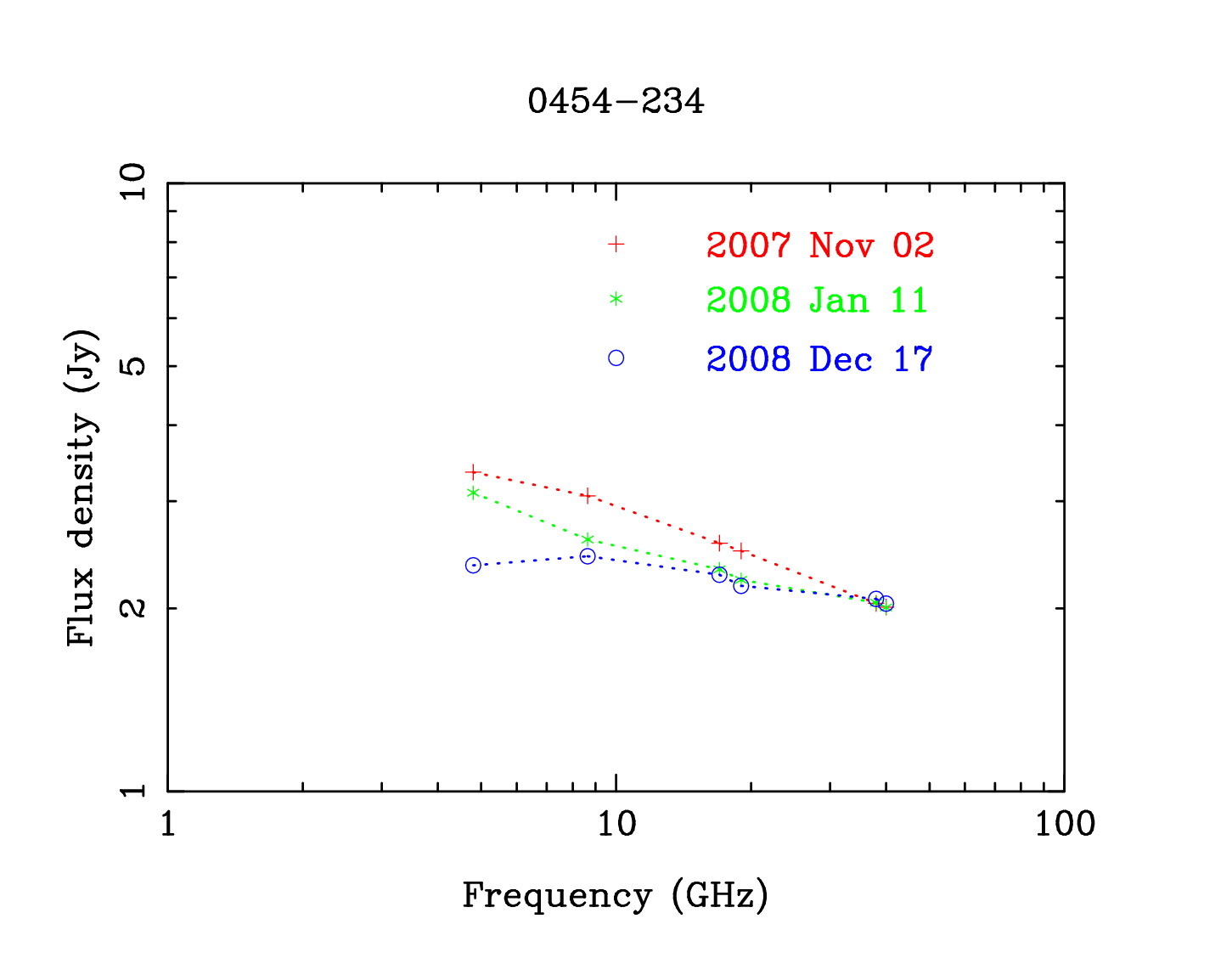
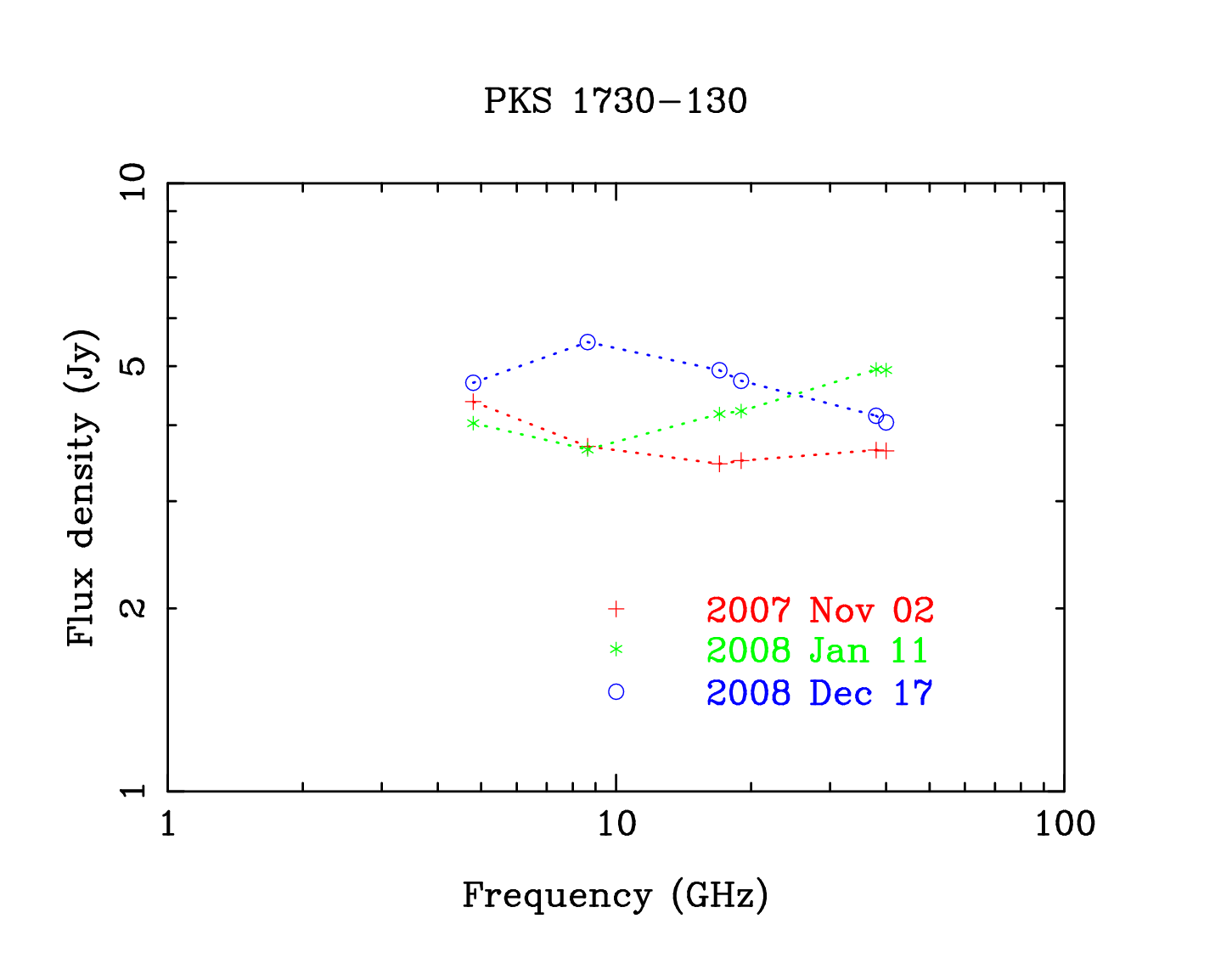
Illustrative multi-epoch results from C1730 are shown in Figures below. The contrasting spectral evolutions of PKS0454-234 and PKS1730--130 are apparent: PKS0454-234 is effectively constant in the 7mm band, with the flux densities decaying at lower frequencies. PKS1730-130, however, shows pronounced variation in all bands, with a quiescent flat spectrum in the first epoch, an inverted spectrum at the higher frequencies in the second epoch, and a steeper spectrum in the third epoch as the flare emission evolves from higher to lower frequencies. This behaviour would be expected to be accompanied by the emergence of a new jet-component on VLBI scales, and increased gamma-ray activity (however as the peak is likely to have occurred before the Fermi launch, this particular case cannot by verified).
|
|
|
A summary of observations made to date is provided in the table below.
| Dates | Array | No. sources | Duration | Notes |
| 2007 Nov 01/02 | 1.5A | 17 | 23 hr | Pre-CABB, pre-Fermi launch |
| 2008 Jan 11/12 | 6A | 20 | 24 hr | Pre-CABB, pre-Fermi launch |
| 2008 Mar 14/15 | 1.5D | 20 | 24 hr | Pre-CABB, pre-Fermi launch |
| 2008 Oct 13/14 | 6A | 17 | 24 hr | Pre-CABB |
| 2008 Dec 17/18 | 750B | 20 | 24 hr | Pre-CABB |
| 2009 Feb 22/23 | EW352 | 45 | 24 hr | Pre-CABB, added Fermi sources |
| 2009 Apr 24/25 | H168 | 73 | 24 hr | CABB, added Fermi sources |
| 2009 May 18/29 | H214 | 73 | 24 hr | CABB, added Fermi sources |
| 2009 Jun 26/27 | H75 | 73 | 23 hr | CABB, added Fermi sources |
| 2011 May 17/18 | 1.5B | 50 | 17.5 hr | CABB, revised source list |
| 2011 Aug 31 | 6B | 36 | 8.5 hr | CABB, revised source list |
| 2011 Sep 13 | 6B | 34 | 12 hr | CABB, revised source list |
| 2011 Oct 15 | 6B | 44 | 12 hr | CABB, revised source list |
| 2011 Nov 02 | 6B | 36 | 9.5 hr | CABB, revised source list |
| 2011 Nov 08/09 | 6B | 53 | 17 hr | CABB, revised source list |
| 2011 Nov 27/28 | 6B | 158 | 19 hr | CABB, 2LAC associations dec < -40deg |
| 2011 Dec 03/04 | 6B | 42 | 11 hr | CABB, 2LAC associations dec < -40deg |
| 2012 Jan 16 | 6B | 51 | 14 hr | |
| 2012 Feb 13/14 | 6B | 45 | 11.5 hr | |
| 2012 Feb 28 | 6B | 47 | 11 hr | |
| 2012 Mar 11/12 | 6B | 28 | 16 hr | |
| 2012 Mar 16 | 6B | 39 | 10 hr | |
| 2012 Apr 1 | H168 | 41 | 10 hr | |
| 2012 May 10 | EW352 | 54 | 19 hr | |
| 2012 May 29 | 6D | 33 | 11 hr | |
| 2012 Jun 14 | 6D | 36 | 7 hr | |
| 2012 Jun 15 | 6D | 34 | 8 hr | |
| 2012 Jul 13 | H168 | 30 | 11.5 hr | |
| 2012 Jul 21 | H75 | 13.5 hr | ||
| 2012 Aug 27 | 6A | 78 | 20 hr | |
| 2012 Sep 4 | 6A | 28 | 11 hr | |
| 2012 Oct 23 | H214 | 30 | 12 hr | green time allocation |
| 2013 Apr 17 | H214 | 12 hr | ||
| 2013 May 11 | 6C | 17 hr | ||
| 2013 Aug 02 | 750D | 6.5 hr | ||
| 2013 Sep 08 | 1.5A | 14.5 hr | ||
| 2013 Sep 20 | H214 | 13.5 hr | ||
| 2013 Nov 10 | 6A | 11.5 hr | ||
| 2013 Nov 29 | EW352 | 9.5 hr | 4cm only (due to weather) | |
| 2013 Dec 11 | 750B | 11.5 hr | 4cm only (due to weather) | |
| 2014 Feb 05 | 6D | 11.5 hr | ||
| 2014 Mar 27 | H168 | 20 hr | ||
| 2014 Apr 7 | H168 | 7 hr | 3hr of allocated 10 given to a NAPA | |
| 2014 Apr 15 | 6A | 2 hr | follow-up of new Fermi source | |
| 2014 Apr 22 | 6A | 5 hr | ||
| 2014 May 16 | 1.5D | 13.5 hr | ||
| 2014 Jun 10 | EW352 | 12 hr | ||
| 2014 Jun 19 | EW352 | 11.5 hr | ||
| 2014 Jul 21 | H75 | 13 hr | ||
| 2014 Sep 14 | 6B | 13.5 hr | ||
| 2014 Oct 30 | 1.5A | 14 hr | ||
| 2014 Nov 19 | 1.5A | 12.5 hr | ||
| 2014 Dec 17 | 6A | 11.5 hr | ||
| 2015 Jan 14 | 6A | 14 hr | ||
| 2015 Feb 03 | 6A | 11.5 hr | ||
| 2015 Feb 08 | EW352 | 15 hr | ||
| 2015 Mar 22 | H214 | 15 hr | ||
| 2015 Apr 24 | 6A | 14 hr | ||
| 2015 May 04 | 6A | 13 hr | ||
| 2015 Jun 29 | 6D | 11 hr | ||
| 2015 Aug 12 | H75 | 15.5 hr | ||
| 2015 Aug 13 | H75 | 14.5 hr | ||
| 2015 Nov 02 | 6A | 13 hr | ||
| 2015 Nov 23 | 1.5A | 13 hr | ||
| 2015 Nov 29 | 1.5A | 15.5 hr | ||
| 2016 Jan 11 | 750C | 16 hr | ||
| 2016 Jan 31 | EW352 | 17 hr | ||
| 2016 Feb 18 | 6B | 14.5 hr | ||
| 2016 Mar 07 | 6B | 11.5 hr | ||
| 2016 Apr 08 | H214 | 12 hr | ||
| 2016 Apr 13 | H214 | 13 hr | ||
| 2016 May 02 | 6A | 8.5 hr | ||
| 2016 May 15 | 6A | 12.5 hr | ||
| 2016 May 27 | 750A | 8.5 hr | ||
| 2016 Jun 01 | 1.5B | 10 hr | ||
| 2016 Jul 26 | H75 | 15 hr | ||
| 2016 Aug 17 | 6C | 12 hr | ||
| 2016 Sep 04 | H168 | 11.5 hr | ||
| 2016 Oct 15 | H168 | 6.5 hr | ||
| 2016 Dec 07 | 6A | 11.5 hr | ||
| 2017 Feb 19 | 6D | 11.5 hr | ||
| 2017 Feb 26 | 6D | 11.5 hr | ||
| 2017 Mar 05 | 6D | 13 hr | 2017 May 7/8 | 6A | 10 hr | 2017 May 26 | 750D | 13 hr | 2017 Aug 15 | EW352 | 12 hr | 2017 Sep 30 | H168 | 10 hr | 2017 Nov 17 | 1.5C | 11.5 hr | 2017 Nov 24 | 1.5C | 11.5 hr | 2017 Dec 6 | 6C | 12 hr | 2018 Jan 19 | 750A | 14.5 hr | 2018 Feb 3 | 750A | 15.5 hr | 2018 Mar 7 | EW352 | 13 hr | 2018 Apr 20 | H168 | 8 hr | 2018 May 20/21 | 6D | 8 hr | 2018 Jun 11 | 6D | 8 hr | 2018 Aug 23 | H214 | 9.5 hr | 2018 Sep 18/19 | 750C | 10.5 hr |
For further information on the c1730 program, please contact Phil Edwards (philip . edwards [at] csiro . au).
This page last modified 15-jun-2018.