



Arrays
Background
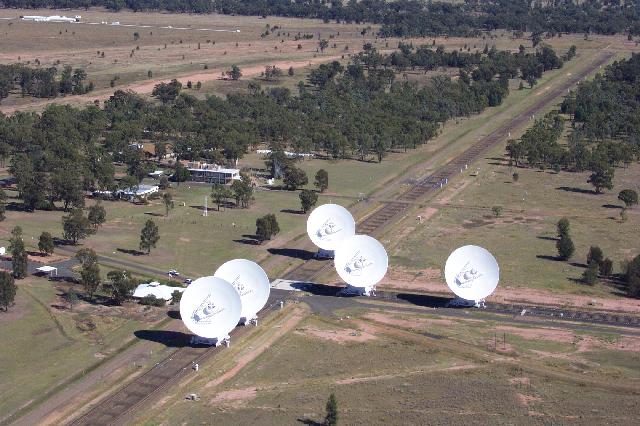
The lay-out of the antenna stations is an important design characteristic of a synthesis array. A range of antenna array configurations are needed to cope with the trade-offs that different observations require between brightness sensitivity, resolution and observing speed. For an array with a modest number of antennas, complementary configurations are needed to fill the (u,v) plane. This was particularly true in the pre-CABB era, when the maximum bandwidth in each IF band was 128 MHz. The 2 GHz bandwidths provided by CABB can result in relatively complete (u,v) coverage in a single array configuration for a continuum source in the cm bands.See:
- ATCA array configurations to be offered in coming semesters.
- The standard ATCA array configurations.
- ATCA Live! for the current configuration.
- A table of previous configurations.
- Station locations for the ATCA.
- Design philosophy of the original station layout, given by: Poulton, G. T., Antenna Layout for the Australia Telescope IAU Symposium - Indirect Imaging, 1983, pages 67-74.
- Background to the construction of the north spur and new stations in 1998.
East-west arrays
The original ATCA design focused on observations at centimetre wavelengths and on sources south of DEC=-25° (where the ATCA had a geographic advantage over northern hemisphere arrays). The design also focused on full syntheses. With these objectives and a modest number of antennas, arguably an east-west array is the best design.The ATCA has a range of east-west configurations that are well suited to imaging with complementary arrays from 214m to 6km in length. A 122m array is also available, giving high brightness sensitivity but many redundant baselines. It is no longer offered routinely, but can be requested and will be considered if sufficiently justified.
Hybrid EW and NS arrays
With the development of observing bands at 12mm and 3mm wavelengths, there was a need to provide arrays that did not require observers to track a source to low elevation (east-west arrays require a 12 hour observation to fill the u-v plane). This is achieved by building a 214m north spur. This allows so-called hybrid arrays, which combine antennas on the east-west and north-south arms of the array. These arrays also allow the ATCA to image at more northern declinations, with reasonable u-v coverage still achieveable at DEC=+20°.Hybrid arrays also allow much greater brightness sensitivity observations (antennas can be packed closer together in two dimensions than in one), and can have less shadowing than east-west arrays (see the shadowing diagrams). Three hybrid arrays are regularly scheduled for the ATCA with baselines up to about 250m.
A single snapshot observation with the hybrid arrays can provide 2D positions and structures for simple sources, whereas at least two and preferably more than three separate hour angles are needed with the EW arrays alone.
Special arrays
On request to the Time Allocation Committee, it is possible to schedule observer-designed special array configurations. These proposals are viewed more favourably if they can justify at least several days of observations, preferably 24 hours per day.Original: Bob Sault (08-Sep-2005)
Modified: Bob Sault (09-Sep-2005)