



Information for the Public
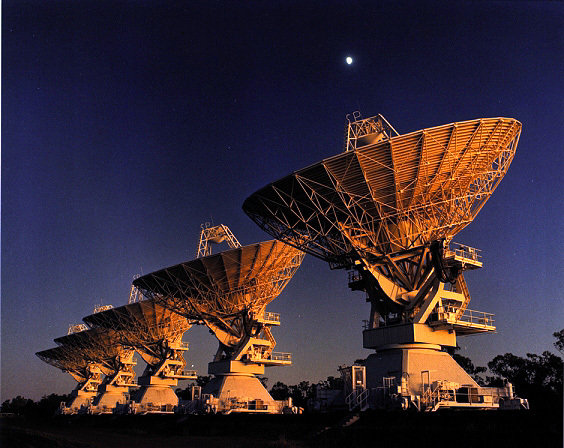
The Australia Telescope Compact Array (ATCA), at the Narrabri Observatory, is an array of six 22-m antennas used for radio astronomy. It is located about 25 km west of the town of Narrabri in rural NSW (about 500 km north-west of Sydney). It is operated by CSIRO's Space and Astronomy business unit and is a part of the Australia Telescope National Facility.
The visitors centre is
OPEN
from 8am to 5pm daily.
Night Photography
We understand that people are interested in coming to site to photograph the telescope and the night sky. We remind the public though that the site shuts to the public at 5pm daily, and that staying overnight is strictly prohibited. This is primarily for the safety of the public and the equipment on site.
In 2026 we are unable to run any night-sky viewing events due to scheduling constraints with array operations.
Useful ATCA links
- ATCA Live! See what the Array is doing this moment!
- Where is it pointing now? See what the Array is seeing this moment (requires Google Earth)!
- The Compact Array Visitors Centre
- Pictures of our telescopes (Compact Array, Parkes and Mopra)
- Astronomical images formed using the Array
- Information on ATCA NASA Tracking (Historical)
- Pictures of the sky around Narrabri
- Wildlife in the region of the observatory
- History, events and major upgrades at the telescope
- The home pages of the Compact Array, Parkes, Mopra and our headquarters.
- Some frequently asked questions and Fun Facts about astronomy and the Australia Telescope.
- Australian Astronomy website is a portal to a variety of sites of interest to both amateur and professional Australian astronomers.
- Radio astronomy educational and outreach resources.
- The Narrabri district Visitors Information service.
What is radio astronomy?
While we normally think of astronomy as being carried out using visible light, modern astronomy now explores a wide range of different wavelengths. This allows the astronomy to study different aspects of the universe. Whereas light is good for studying stars, radio waves allow us to study things like
- cold hydrogen gas clouds,
- energetic electrons spiraling around near massive black holes,
- pulsars (rapidly rotating ''dead'' stars)
- the glow left behind by the Big Bang 13-billion years ago.
Radio astronomy opens a completely different window on the Universe to that accessible by visible light.
What does the Array do?
The ''Compact Array'' is the premier instrument of its kind in the southern hemisphere. It operates 365-days per year, 24-hours per day. Its business is pure science. It is not used for any military activities.
These antennae work together using a technique called ''interferometry'' which allows the antennas to mimic a much larger antenna. This gives the telescope the ability to see very fine detail. Effectively ''radio interferometry'' works by replacing the lens of a conventional imaging system with sophisticated electronics, supercomputer-like hardware and complex software. Using this technique, a image of a small section of the sky can be formed in a 12-hour period. Whereas the Array uses six antennas spread over 6km, the same interferometry principles can be applied to antennas spread over a continent. For example, several times a year, the Array is used together with other radio telescopes spread across Australia (such as the Parkes antenna) to make images with extremely fine detail.
About us
The Array is operated by CSIRO's Australia Telescope National Facility. It operates three telescopes: the Compact Array, Parkes and the Australian Square Kilometre Array Pathfinder (ASKAP) telescope in the Mid-West of Western Australia. The National Facility supports Australia's research in radio astronomy.
The telescopes are used by a broad collection of astronomers. In the case of the Compact Array, about a third of these are from within CSIRO, about another third are from other Australian research institutions, and the remaining third is used by overseas astronomers. In recent years remote observing mode has become the norm, with astronomers accessing the instrument either from Marsfield (in Sydney) or their home institution, rather than visiting the site. On average, two astronomy projects are underway at different times of the day. The average observation duration is about 3 days.
Use of our telescopes is based purely on scientific merit. Astronomers make scientific proposals to use them. These are peer reviewed, and the best proposals are then granted time. No charge is made for the use of the telescopes.
Other observatories on site
In addition to the Compact Array, the site hosts two other astronomical or space physics observatories:
- Bureau of Meteorology - Space Weather Services
- A node of the Birmingham Solar Oscillation Network (BiSON)
About the Narrabri area
The observatory is 25 km from Narrabri township, on a road linking Narrabri and Wee Waa. A separate document gives directions for getting to the observatory.
Yarrie Lake, a 1.5km-diameter circular lake, is located about 10 km south-west from the observatory, and is well worth a visit. It is a beautiful spot for a picnic.
Narrabri has a population of about 7,250 and is the centre of a large irrigation and dry-land farming district which produces cotton, oilseed, premium grade wheat, grain sorghum, and raises cattle and sheep.
Narrabri is situated on the banks of the Namoi River, 420 km north-west of Sydney, 40 km west of the Nandewar Range. It is 120 km from Coonabarabran where Mopra, the eighth Australia Telescope antenna, is located. There are three research stations in the Narrabri District: the University of Sydney's Plant Breeding Institute, the Australian Cotton Research Institute and the Australia Telescope National Facility.
The Mount Kaputar National Park is located in the Nandewar Ranges just to the east of Narrabri. The Park, like the Warrumbungle National Park near Coonabarabran (and the Siding Spring optical observatories) is of recent volcanic origin. It covers an area greater than 40,000 hectares and contains about 12 peaks over 1000 m high. The highest is Mount Kaputar at 1511 m above sea level. Camping areas and cabins are located at Dawson Spring and Bark Huts on the Kaputar Plateau. Many walking trails have been developed in the area but much of the Park is being managed as a wilderness area.
Between Narrabri and Coonabarabran to the south-west lies the 465,000-hectare Pilliga scrub. A large part of this area is preserved as the Pilliga National Park. The area is a mass of wild flowers in spring and is home to emus, kangaroos and wallabies.
Other district attractions include Keepit Dam, upstream on the Namoi River. The sophisticated cotton-growing industry is located downstream from Narrabri, and is based on irrigation from the dam. Across the Nandewar Range to the east are located some of the state's most interesting gem and rock fossicking areas.
Original: Bob Sault (27-Nov-2002)
Modified: Peter Mirtschin (20-Feb-2026)